
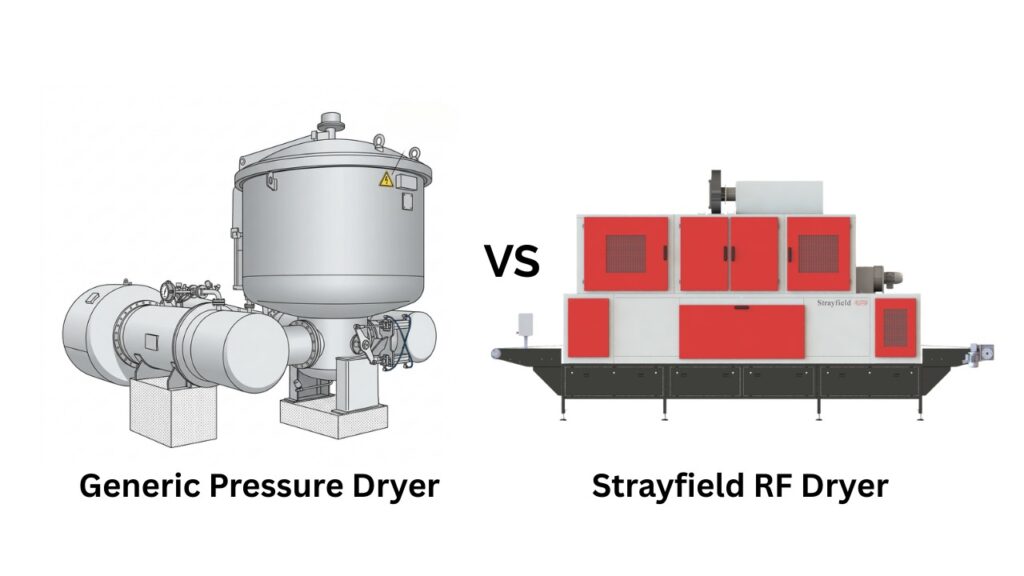
Why Modern Textile Mills Are Re-evaluating Yarn Drying
Every textile mill optimises energy economics. Every mill negotiates utility rates.
And yet, drying continues to quietly influence:
- Cost per kg
- Production flow
- Shade consistency
- Rewinding performance
- Overall profitability
The real difference between drying technologies is not just how they dry. It is how they behave in production.
Process First: How the Two Technologies Differ
Conventional Pressure Dryer
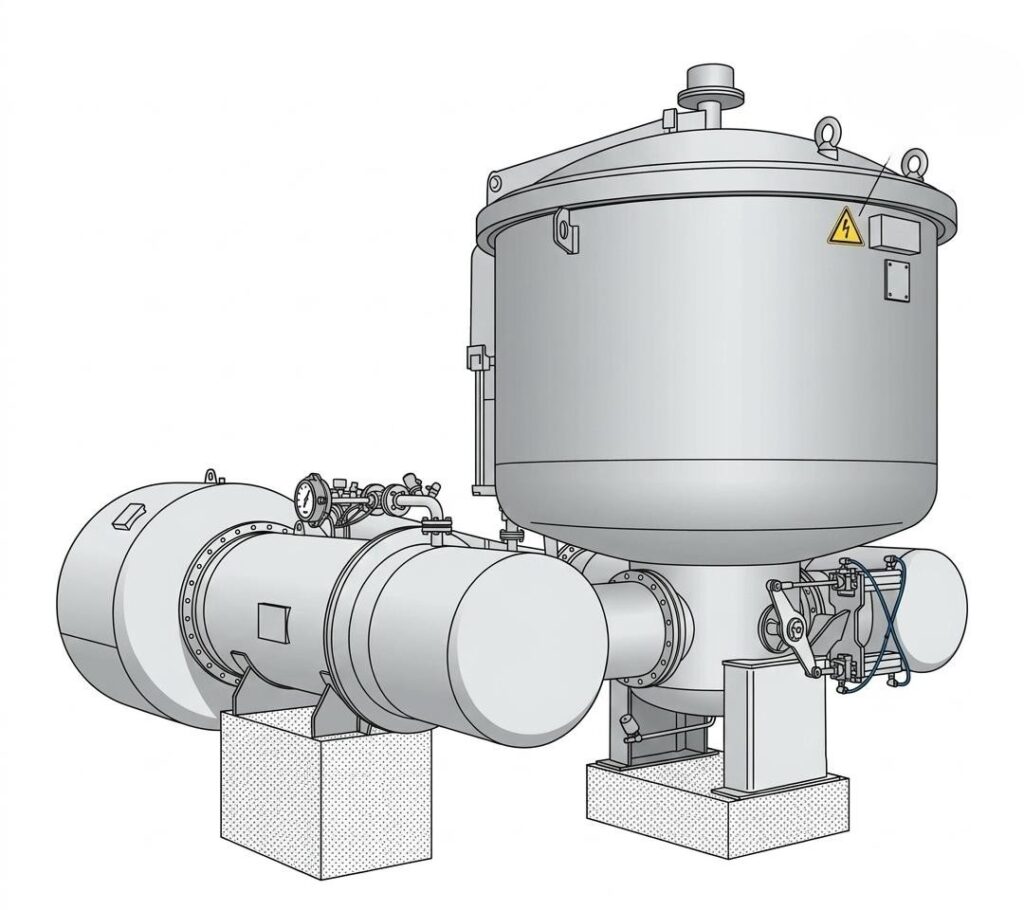
Pressure dryers are designed as sealed, pressurised systems for package yarn drying. They are robust and widely used, especially in dyehouse environments.
Process Characteristics:
- Batch-based operation
- Fixed drying cycles
- High-temperature chamber environment
- Designed for full-load efficiency
Production follows a defined sequence:
- Load
- Heat up
- Dry
- Cool
- Unload
This makes the process stable but also cycle-dependent.
RF Dryer + Hydro Extraction
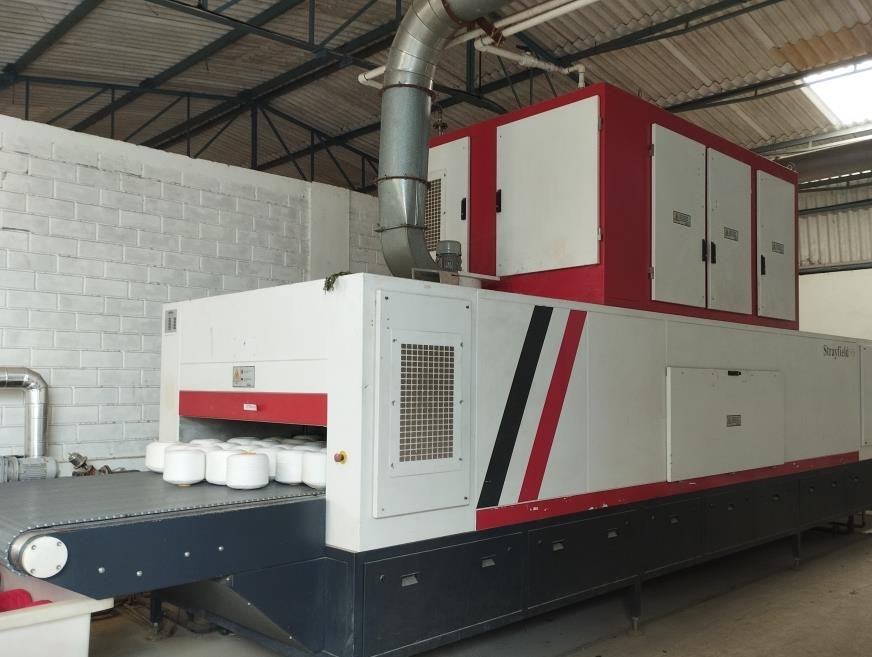
RF drying works on a different principle.
Instead of heating the chamber, it heats moisture inside the yarn. This results in:
- Volumetric internal heating
- Uniform moisture removal
- Lower thermal stress on yarn
- Continuous material flow
Process Characteristics:
- Continuous operation
- No fixed cycle dependency
- Energy applied directly to moisture
- Start-stop flexibility
What This Means on the Shop Floor
1. Batch vs Continuous Flow
Pressure drying is cyclical. RF drying is continuous.
This directly impacts:
- Throughput stability
- Machine utilisation
- Production planning
2. Temperature s Yarn Quality
Pressure drying relies on elevated chamber temperatures.
RF drying operates through internal heating, typically at lower bulk temperatures. Impact:
- Reduced dye migration risk
- Better shade consistency
- Lower yarn stress
3. Load Sensitivity
Pressure dryers are optimised for full capacity. At partial loads:
- Energy remains similar
- Cycle time remains similar
- Cost per kg increases RF systems adapt.
Less moisture = less energy used.
4. Operational Flexibility
Pressure dryers perform best in repetitive, uniform batches. RF enables:
- Mixed shade processing
- Faster changeovers
- Reduced idle time
- More responsive production
Now Let’s Talk Numbers
Disclaimer:
The following calculations are based on operating data from one specific site and defined utility rates. Actual results may vary depending on plant conditions, yarn types, and energy costs. For an accurate assessment, a customised evaluation is recommended.
Assumed Production s Utility Basis
- Production: 5 tons (3,500 kg) per day
- Electricity: $ 1 per kWh
- Thermal energy: $ 21 per kg
Pressure Dryer – Operating Snapshot
- 388 kg batch capacity
- 5-hour cycle
- 104 kW power draw
- 3 kg thermal energy per kg yarn This results in a drying cost of:
$ 1.04 per kg
This assumes full-load operation.
At lower loads, cost per kg increases.
RF Dryer + Hydro – Operating Snapshot
(Based on 85 kW RF configuration)
- 230 kg per hour throughput
- 130 kWh power consumption
- 45 kg thermal support
- 8 kWh chiller load
- Maintenance included
This results in a total drying cost of:
$ 0.73 per kg
The Cost Difference
Parameter | Pressure Dryer | RF Dryer |
Operation | Batch | Continuous |
Energy Pattern | Fixed | Moisture-linked |
Cost per kg | $ 1.04 | $ 0.73 |
Difference: $ 0.31 per kg
At 3.5 tons per day:
- $ 1,085 saved per day
- $ 27,125 saved per month
- $ 325,500 saved per year Utility-only
The Bigger Shift
Pressure dryers are proven and reliable. But their economics are tied to:
- Batch cycles
- Fixed energy input
- Load dependency
RF drying changes the model.
From:
- Heating the environment
To:
- Targeting moisture directly
From:
- Fixed consumption
To:
- Adaptive energy use
For mills operating at scale, this is not just a process change. It is a cost and control advantage.

