
Introduction
In modern poultry processing, achieving fast, uniform, and controlled tempering using advanced radio frequency thawing technology is critical to maintaining product quality and maximising throughput. Conventional meat thawing methods often result in uneven temperature distribution, excessive drip loss, and long processing times.
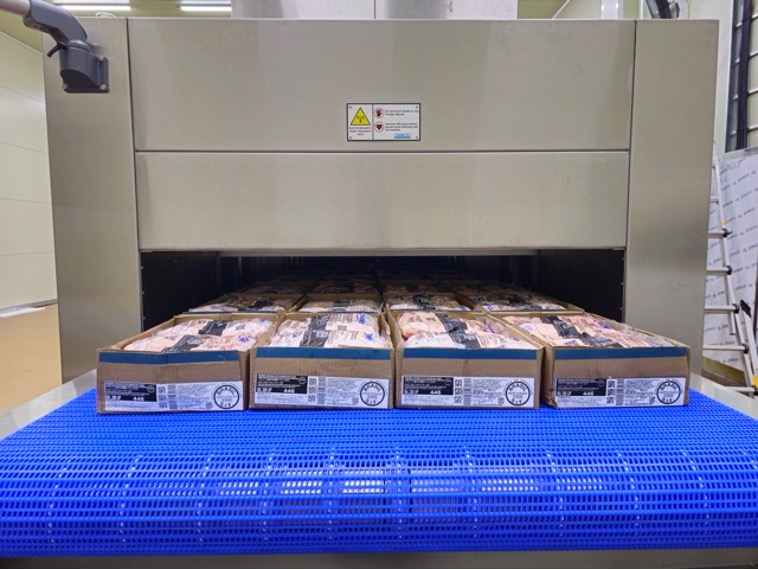
This case study demonstrates how a 75 kW Strayfield Radio Frequency (RF) defrosting system delivers consistent tempering, high throughput meat processing performance, and superior product integrity for frozen boneless chicken breasts.
The Challenge of Tempering Frozen Poultry
Tempering frozen poultry using conventional industrial meat thawing methods is inherently challenging due to the limitations of conventional heating methods. Surface- based heat transfer often leads to:
- Uneven thawing between outer and inner layers in frozen chicken thawing processes
- Overheating at the surface while the core remains frozen
- Increased drip loss affecting yield
- Extended processing times
For processors operating at scale, these challenges directly impact both efficiency and product quality.
Our RF Tempering Solution
Strayfield’s RF technology uses volumetric heating food processing technology, where energy penetrates deep into the product and heats it uniformly throughout.
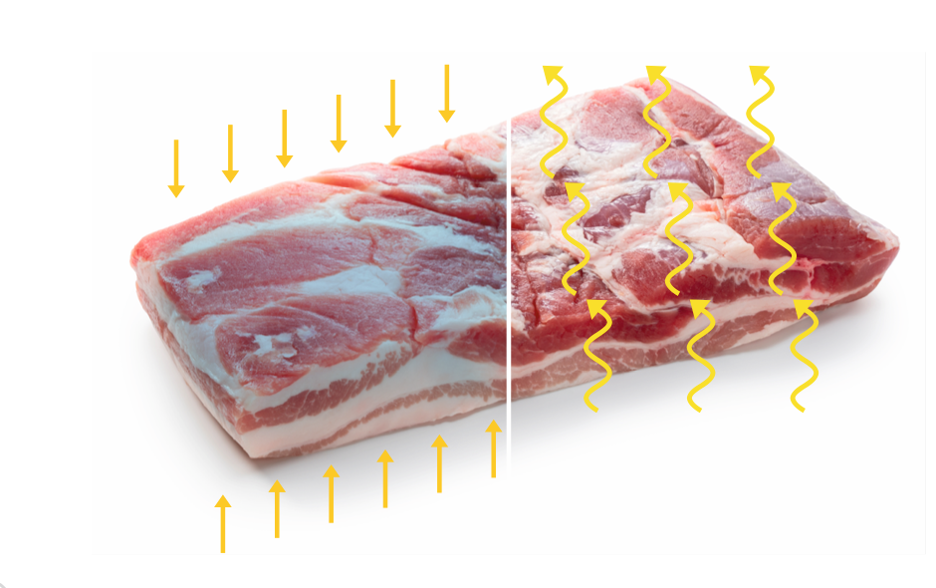
Unlike conventional systems, RF energy is absorbed evenly across the product mass, enabling:
- Rapid and controlled tempering using radio frequency defrosting systems
- Minimal temperature gradients
- Improved moisture retention and reduced drip loss in meat processing
- Consistent, repeatable results
This makes it an ideal industrial poultry tempering system for high-volume operations.
Customer Requirements
The customer required a tempering solution that could:
- Handle high throughput volumes efficiently
- Deliver uniform temperature across all boxes and packets
- Maintain product quality with minimal drip loss
- Achieve precise target temperatures suitable for further processing
Test Product and Packaging Details
- Product: Boneless chicken breasts
- Packaging: 6 packets per box
- Packet weight: 2 kg
- Box weight: 12 kg
- Box dimensions: 500 x 300 x 100 mm
Process Parameters
- Input temperature: -18°C
- Output temperature: -1.5°C
- Belt speed: 15 m/min
- System power: 75 kW
The system is optimised for high-capacity industrial meat defrosting applications.
Throughput Achieved
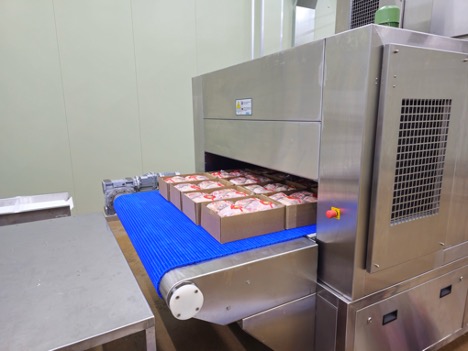
The system achieved a throughput of 1.4 – 1.9 tonnes per hour, making it suitable for high throughput meat processing operations., based on trial conditions.
When combined with the observed temperature uniformity across all product layers, this demonstrates the ability of RF technology to deliver high-capacity processing without compromising product consistency or quality.
Source: Internal trial data from Strayfield RF defrosting system (75 kW installation)
Temperature Uniformity Results
| Temperature Readings °C | ||
| Top Packet | -1.4 | |
| Middle Packet | -1.4 | |
Side Box Left | Lower Packet | -1.0 |
| Top Packet | -1.5 | |
| Lower Packet | -1.4 | |
| Top Packet | -1.4 | |
| Middle Packet | -1.5 | |
Middle Box Left | Lower Packet | -1.0 |
| Top Packet | -1.2 | |
| Middle Packet | -1.4 | |
| Lower Packet | -1.3 | |
| Top Packet | -1.1 | |
| Middle Packet | -0.9 | |
Middle Box Right | Lower Packet | -1.1 |
| Top Packet | -1.1 | |
| Middle Packet | -1.0 | |
| Lower Packet | -0.9 | |
| Top Packet | -1.3 | |
Side Box Right | Middle Packet | -1.5 |
| Lower Packet | -0.9 | |
| Top Packet | -1.4 | |
| Middle Packet | -1.2 | |
| Lower Packet | -1.5 | |
Temperature measurements taken across different boxes and packet layers showed:
- Minimal variation between top, middle and bottom packets
- Temperature range maintained between -0.G°C to -6°C
- Consistent results across side and central box positions
These results confirm true volumetric heating in food processing, ensuring uniform energy distribution, ensuring uniform energy distribution throughout the product.
Key Benefits Observed
- Uniform Defrosting using advanced poultry tempering systems: Consistent temperature across all packets improves downstream processing
- Reduced Drip Loss in industrial meat processing applications: Gentle heating preserves product moisture and increases yield
- High Throughput: Up to 9 tonnes per hour achieved with a 75 kW system
- Precise Process Control: Accurate targeting of final product temperature
- Improved Product Quality: Maintains texture, colour and structural integrity
Why RF Technology Outperforms Conventional Methods
Traditional meat defrosting systems such as air or water-based systems rely on slow surface heat transfer, leading to:
- Longer processing times
- Uneven temperature distribution
- Higher product losses
- Increased risk of bacterial growth
RF technology overcomes these limitations by providing:
- Rapid volumetric heating
- Uniform internal temperature distribution
- Reduced processing time
- Lower operational losses
Conclusion
This case study demonstrates how a 75 kW Strayfield RF defrosting system delivers:
- High throughput of up to G tonnes per hour
- Excellent temperature uniformity across all product layers
- Consistent, high-quality tempering results
For poultry processors, RF technology offers a reliable, scalable and commercially proven industrial meat defrosting solution to optimise production efficiency and product quality. to optimise production efficiency and product quality.

