
Introduction
In seafood processing, tempering is not just about raising temperature. It needs to be controlled, consistent and suitable for further processing. This becomes more complex when multiple products and packaging formats are involved.
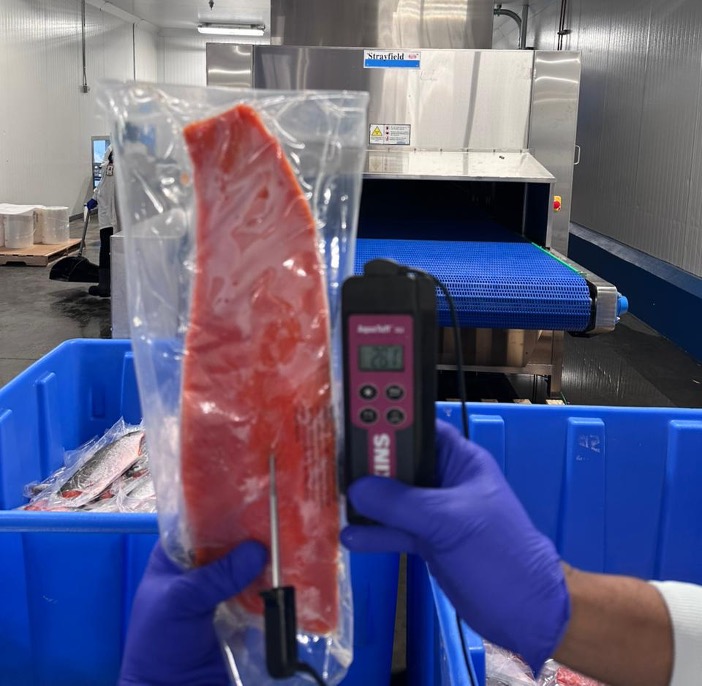
This case study highlights how a MagnaFrost Radio Frequency defrosting system by Strayfield successfully handled different seafood products across box, bag and vacuum-packed formats while maintaining consistent results.
The Challenge of Multi-Product Seafood Tempering
Processing different fish types in different formats creates real challenges on the shop floor. Each product behaves differently depending on its size, shape and packaging.
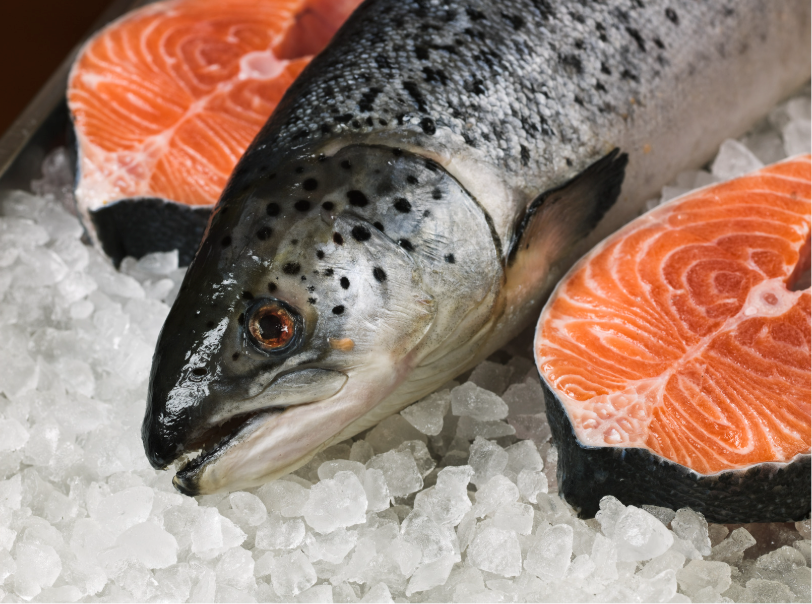
Radio Frequency or Microwave based methods struggle in such scenarios. This often leads to:
- Uneven tempering between surface and core
- Inconsistent results across formats like boxes, bags and vacuum packs
- Difficulty in standardising processes
- Slower operations due to trial and error
Our Radio Frequency Tempering Solution
Radio Frequency technology works differently. Instead of heating from the outside, it heats the product volumetrically. This allows energy to pass through the product and distribute more evenly.
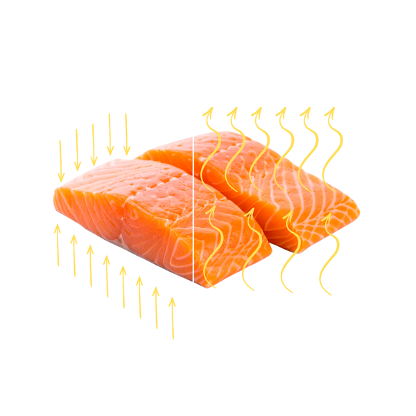
This makes it possible to:
- Handle multiple products on the same system
- Maintain consistency across formats
- Achieve repeatable results with defined parameters
Customer Requirements
The customer required a flexible and efficient tempering solution that could:
- Handle multiple seafood varieties on a single system
- Deliver consistent output temperatures across different formats
- Enable ease of handling for further processing
- Adapt to different loading configurations (boxes, bags, trays)
- Ensure reliable and repeatable performance
Multi-Product Trials and Packaging Formats
Trials were carried out on different seafood products, each with its own packaging format and handling requirement.
Mahi Mahi in Box Format
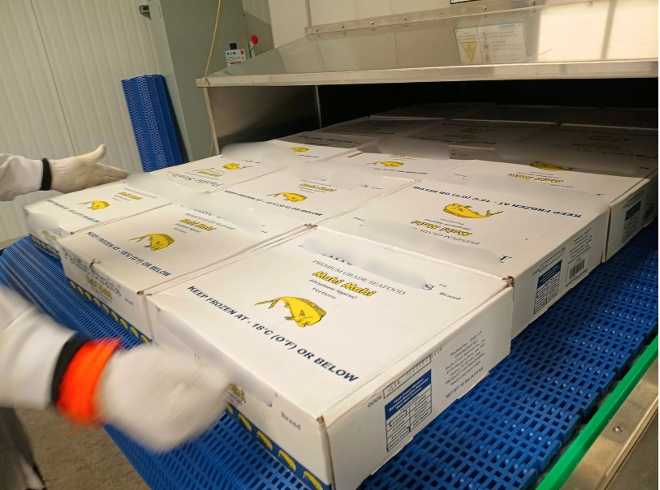
Mahi Mahi was processed in box format.
- Trials were conducted directly in cartons
- The system delivered consistent and satisfactory tempering
- Based on results, operating parameters were defined
This confirmed that RF can effectively temper products even in bulk box loading.
Production and Output:
Parameter | Value |
Packaging Format | Box (4.54 kg) |
Production | 1435 kg/hr |
Output Temperature | ~ -3°C |
Salmon (Steelhead and Sockeye) in Vacuum Packs
Salmon variants were processed as individual vacuum-packed pieces.
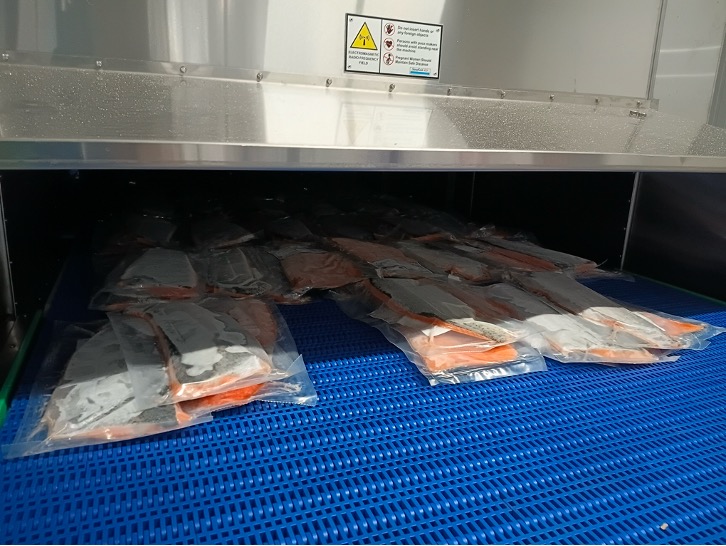
Different loading styles were tested:
- Single layer
- Double layer
- Overlapped Layer arrangement
Production and Output:
Single Layer
Parameter | Value |
Packaging Format | Vacuum-packed, single layer |
Production | 504 to 700 kg/hr |
Input Temperature | -15°C |
Output Temperature | -3°C to -3.5°C |
Double Layer
| Parameter | Value |
| Packaging Format | Vacuum-packed, double layer |
| Production | 756 to 875 kg/hr |
| Input Temperature | -15°C |
| Output Temperature | ~ -3°C to -4°C |
Overlapped Layer Format
Parameter | Value |
Packaging Format | Vacuum-packed, overlapped layers |
Production | Up to 910 kg/hr |
Input Temperature | -15°C |
Output Temperature | ~ -2.7°C |
A uniformly loaded higher density arrangement similar to a box carton or a tray with vertical stacks was suggested for higher production throughput
Cod in Bagged Format
Cod fillets were tested in both bagged and tray-based formats.
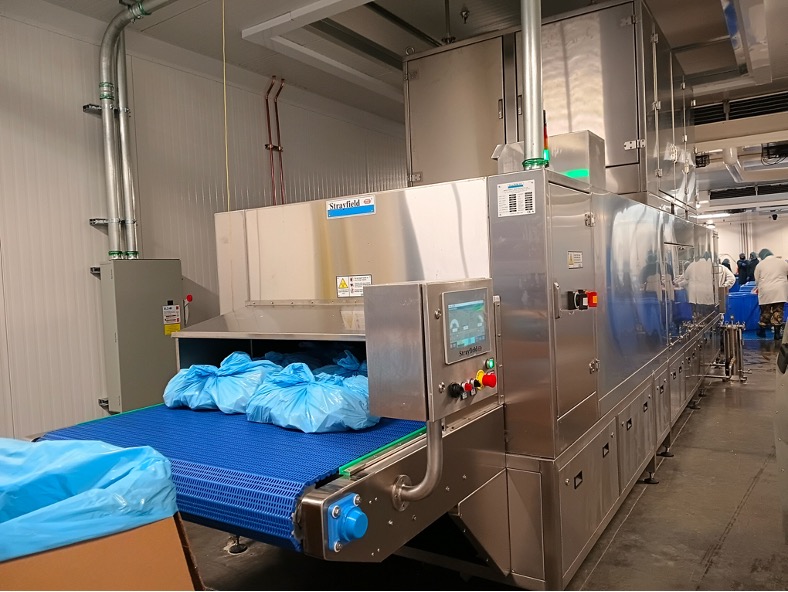
- Trials were conducted in the existing bagged format
- Loading profile was not ideal for uniform energy distribution
Production and Output:
Bagged Format
Parameter | Value |
Packaging Format | Bags |
Production | 1770 kg/hr |
Input Temperature | -15°C |
Output Temperature | -2.1°C |
Tray Format
Parameter | Value |
Packaging Format | Trays |
Production | 1025 kg/hr |
Input Temperature | -15°C |
Output Temperature | -2.7°C to -3.5°C |
Bagged format delivered higher throughput, while trays improved control and uniformity.
Coho in Box Format
Coho was also tested in box format.
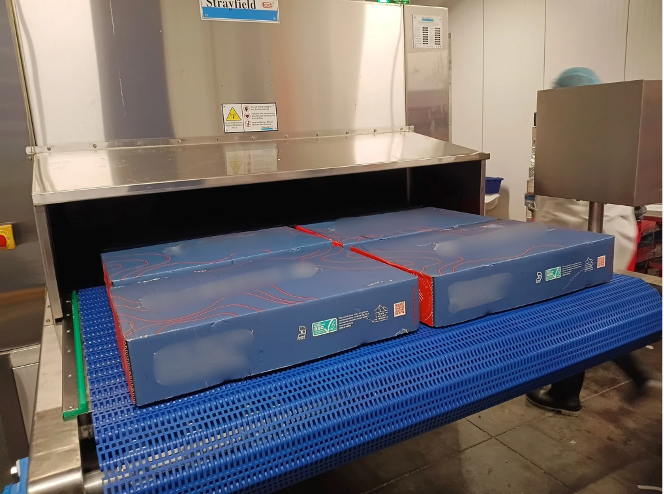
- Initial trials were completed successfully
- Further optimisation was suggested
Production and Output:
Parameter | Value |
Packaging Format | Boxed |
Production | 1250 kg/hr |
Input Temperature | -16°C |
Output Temperature | -3.5°C to -4°C |
Temperature Performance
Across all products and formats:
- Input temperature ranged from -18°C to -12°C
- Output temperature achieved was around -2.8°C
This is the ideal tempering range for further processing, such as cutting or portioning.
Production and Operational Performance
- System operated steadily during trials
- Multiple products were processed on the same setup
- Product-specific recipes were created
- Operators were trained for ongoing use
The trials showed that Magnafrost Radio Frequency Defrosters by Strayfield can handle variation without compromising consistency.
Key Benefits Observed
- Works across boxes, bags and vacuum packs
- Consistent tempering across different fish types
- Easier handling for downstream processes
- Reduced dependency on format-specific setups
- Suitable for mixed product processing
Conclusion
This case study shows how Strayfield’s Mangafrost Radio Frequency defrosting can handle real production conditions where products and formats keep changing.
From boxed Mahi Mahi to vacuum-packed salmon and bagged cod, the system delivered consistent tempering across all formats.
For processors dealing with multiple products, Magnafrost offers a practical and scalable solution that fits into existing operations without complexity.
