
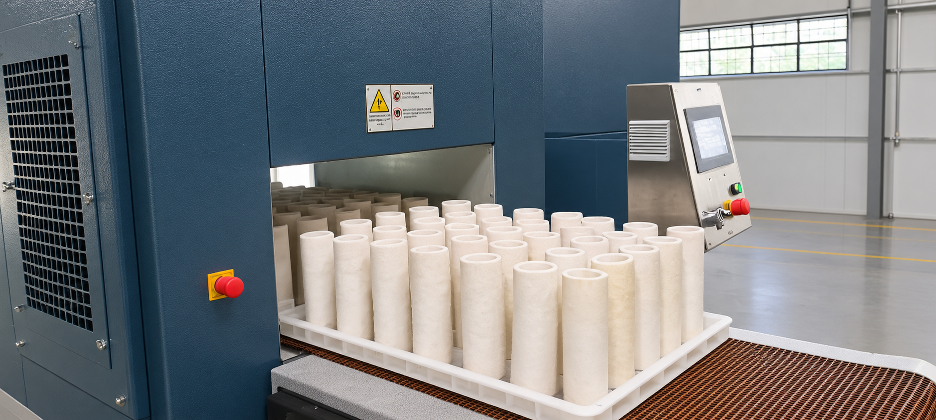
In technical ceramics, how moisture is removed can be just as important as how quickly it is removed. Radio Frequency (RF) drying offers an alternative approach to managing moisture gradients and reducing the risk of drying defects.
Why Is Ceramic Drying So Challenging?
Technical ceramics are used in demanding industrial applications where dimensional accuracy, structural integrity and consistent product quality are essential. Products such as ceramic fibre boards, crucibles, sleeves, peep doors and ceramic paper must undergo controlled drying before they are ready for further processing or use.
However, drying wet-formed ceramic products presents a significant challenge. Moisture must be removed without compromising the product’s structure. Depending on the material, geometry and initial moisture content, drying can be a lengthy process that consumes considerable energy and limits production throughput.
The challenge is not simply removing water. It is removing it uniformly.
The Problem with Uneven Drying
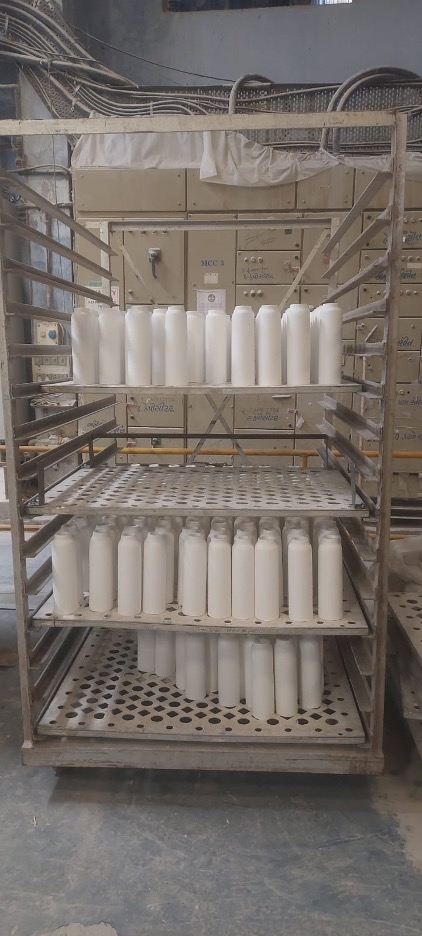
In conventional hot-air drying, heat is transferred from the surface towards the interior of the product. This can cause the outer layers to dry faster than the core, creating differences in moisture content and shrinkage throughout the material.
These variations can generate internal stresses, increasing the risk of surface cracking, warping and other defects. Thicker products can be particularly challenging because moisture in the interior may take longer to escape.
For manufacturers, the consequences can extend beyond individual defective products. Cracking and deformation can lead to material waste, rework and lower production yields. Longer drying cycles can also restrict throughput, making it difficult to balance product quality with manufacturing efficiency.
Increasing the temperature or extending the drying time does not necessarily resolve the underlying issue: moisture may still be distributed unevenly throughout the product.
How Radio Frequency Drying Can Help
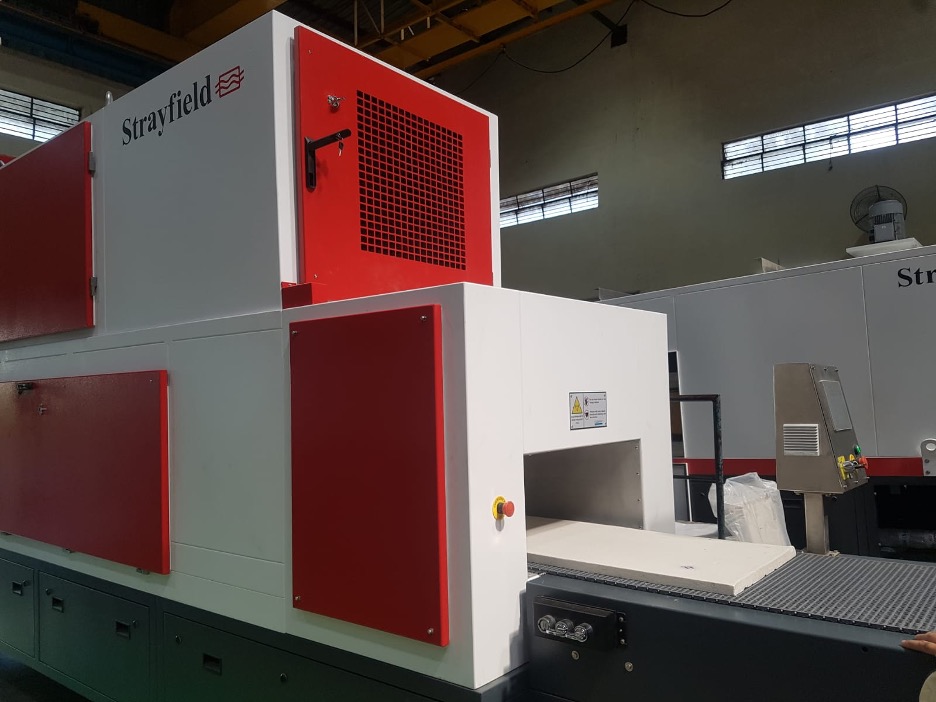
Strayfield MagnaDry Radio Frequency (RF) drying offers a different approach by using RF energy to generate heat within moisture-containing materials, rather than relying solely on heat transferred from the surface.
This volumetric heating mechanism can help moisture throughout a product heat more directly, supporting more uniform drying conditions. For suitable ceramic applications, RF technology can help reduce moisture gradients that contribute to internal stresses and drying defects.
Strayfield’s RF drying technology can be configured for different industrial product requirements. Features such as flat plate electrodes and low-density RF fields support controlled energy application, with the system designed around the product and process.
Depending on the ceramic material, product dimensions and existing drying method, RF drying may also help shorten drying cycles and improve energy efficiency. Hybrid RF and hot-air systems can be considered where a combination of volumetric heating and conventional drying is appropriate.
From Defect Reduction to Process Efficiency
For ceramic manufacturers, the potential value of RF drying goes beyond speed alone. More consistent moisture removal can support improved product quality, while shorter drying cycles may create opportunities to increase throughput and reduce the resources required per production batch.
The results will depend on factors including material composition, product thickness, initial moisture content and the required final moisture level. Trials using representative products are therefore important to establish the most suitable process conditions and quantify the benefits.
Moving Towards Electrically Powered Drying
Unlike conventional systems that rely on gas or fuel-based heaters to generate heat, Radio Frequency drying uses electrical energy to heat moisture within the product. This offers manufacturers an alternative to combustion-based heating, with the potential to reduce reliance on fossil fuels at the point of use.
By combining volumetric heating with a carefully controlled drying process, RF technology can support energy-efficient production. The overall environmental impact and operating cost will depend on factors such as electricity tariffs, the energy source, system efficiency and process requirements.
A More Controlled Approach to Ceramic Drying
Cracking and uneven drying remain important considerations when processing technical ceramics. Addressing these challenges requires a drying method that considers how moisture moves through the product, not simply how much heat is applied.
By enabling volumetric heating, Radio Frequency technology offers manufacturers another way to approach this challenge, with the potential to improve drying uniformity, reduce defects and support more efficient production.
Explore how Strayfield’s MagnaDry Radio Frequency technology could support your ceramic drying process.
