
Solving Live Insect Infestations Without Chemicals
The Challenge:
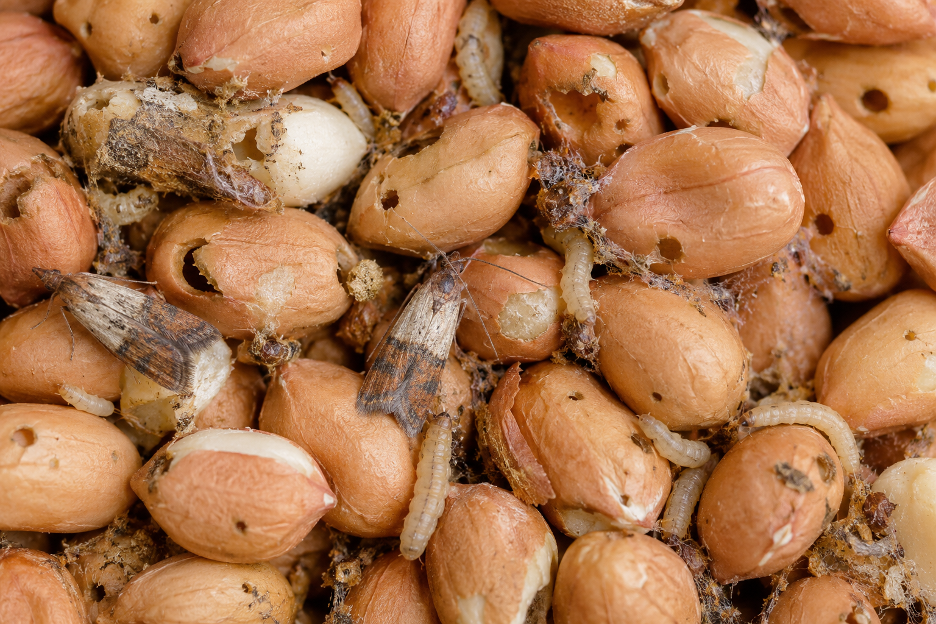
Stored-product insect infestations remain one of the biggest quality and food safety challenges for peanut processors worldwide. Live insects such as Indian Meal Moths, flour beetles, and internal larvae can remain hidden within bulk peanuts, leading to product rejection, reduced shelf life, export non-compliance, and significant financial losses.
Traditional pest control methods, including chemical fumigation, are becoming increasingly challenging due to tightening regulations, residue concerns, growing consumer demand for chemical-free processing, and the limited ability of conventional treatments to effectively target insects hidden inside the product.
Radio Frequency (RF) technology offers a modern alternative. Unlike conventional heating methods, RF generates rapid volumetric heating throughout the product, enabling effective disinfestation while maintaining product quality. By exploiting the natural dielectric differences between insects and peanuts, RF selectively heats pests faster than the surrounding product, delivering effective insect control without the use of chemicals.
This case study presents the results of a Radio Frequency disinfestation trial conducted on heavily infested raw peanut kernels, demonstrating how RF technology can eliminate live insect infestations while preserving the quality of the product.
The Science Behind RF Disinfestation: Differential Heating
Radio Frequency (RF) technology heats food differently from conventional methods. Instead of transferring heat from the surface inward, RF energy penetrates the product and generates heat throughout the entire mass simultaneously. This results in faster, more uniform heating.
The key to RF disinfestation lies in a phenomenon known as differential heating.
Insects naturally contain more moisture than dry peanuts. Because of this difference in composition, they absorb Radio Frequency energy much more efficiently than the surrounding product. As a result, the insects heat up much faster than the peanuts themselves.
This allows the insects to reach their lethal temperature before the peanuts become excessively hot. In simple terms, RF targets the insects rather than the product, enabling effective disinfestation while helping maintain peanut quality.
Differential Heating in Practice
The following graphs illustrate this principle using data from an independent study on insects in walnuts. Although the study was conducted on walnuts, the same scientific principle applies to other low-moisture products such as peanuts because insects exhibit similar dielectric behaviour in both commodities.
Figure 1. shows how insect larvae heat during 27 MHz Radio Frequency treatment.
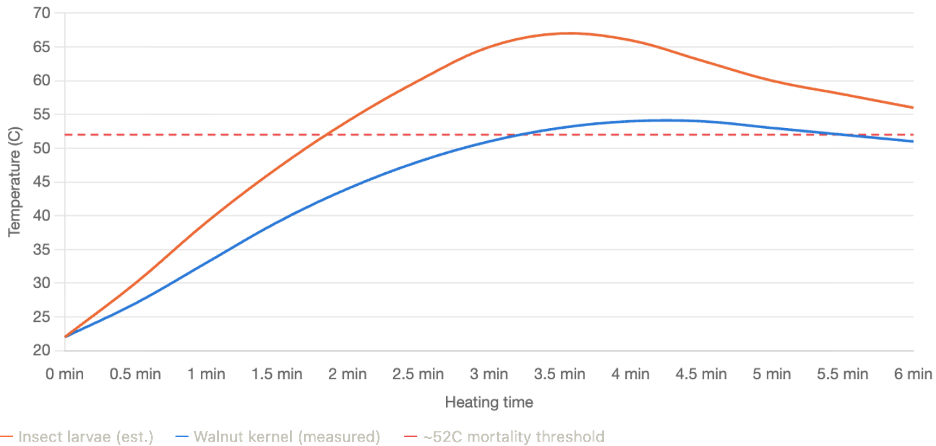
While the walnut kernel gradually reaches approximately 52°C, the insect temperature rises much more rapidly, exceeding 65°C. This demonstrates that insects absorb RF energy at a faster rate, allowing them to reach lethal temperatures while the surrounding product remains significantly cooler.
Figure 2. compares 27 MHz Radio Frequency with 915 MHz microwave heating.
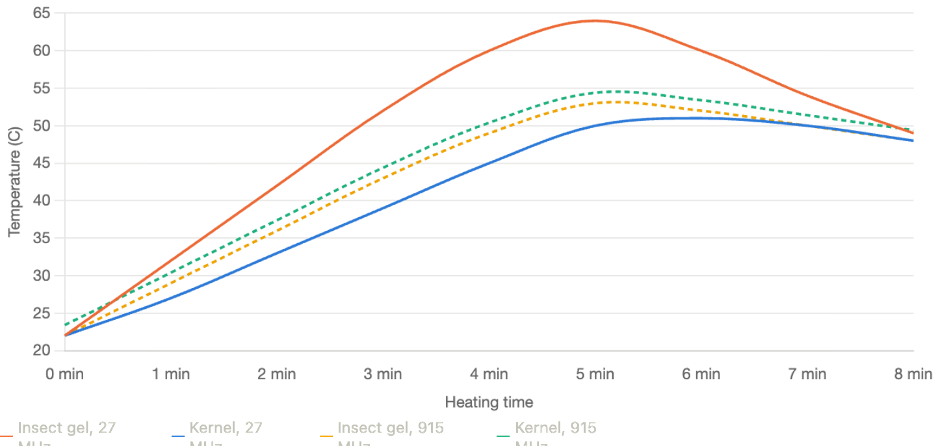
With 27 MHz RF, the insect becomes significantly hotter than the surrounding kernel, creating the temperature difference required for effective disinfestation. In contrast, 915 MHz microwave heating causes both the insect and the kernel to heat at nearly the same rate, resulting in little or no selective heating.
Source: Graphs adapted from Wang, S., Tang, J., Cavalieri, R.P., & Davis, D.C. (2003). Differential Heating of Insects in Dried Nuts and Fruits Associated with Radio Frequency and Microwave Treatments. Transactions of the ASAE, 46(4), 1175–1182.
Why This Matters
This selective heating effect is what makes Radio Frequency technology particularly effective for disinfestation. By heating insects faster than the product itself, RF can achieve reliable insect mortality while reducing unnecessary thermal exposure to the food. The result is a chemical-free, energy-efficient process that helps preserve product quality while meeting insect control requirements.
Source: Adapted from Differential Heating of Insects in Dried Nuts and Fruits Associated with Radio Frequency and Microwave Treatments, Wang, Tang, Cavalieri & Davis, Transactions of the ASAE, Vol. 46(4), 2003.
Trial Overview
Objective
The objective of this trial was to evaluate the effectiveness of Radio Frequency (RF) technology in eliminating live insect infestations from raw peanut kernels while maintaining product quality.
The trial was designed to validate whether RF disinfestation could:
- Eliminate live insects in a heavily infested peanut batch.
- Demonstrate the effectiveness of RF as a chemical-free alternative to conventional fumigation.
- Assess the suitability of the process for commercial peanut processing applications.
Test Sample
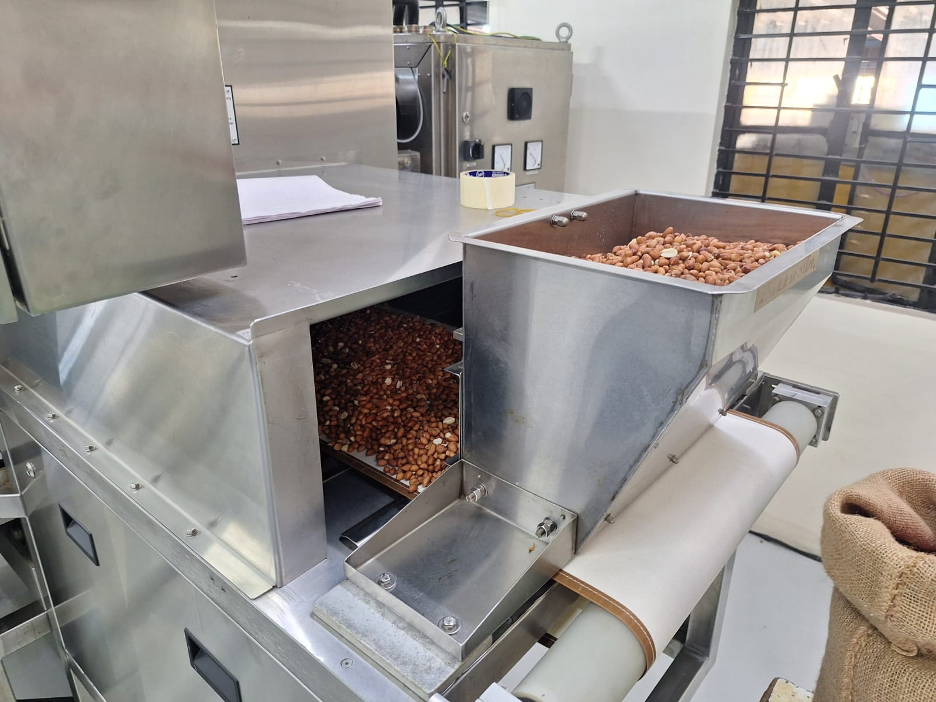
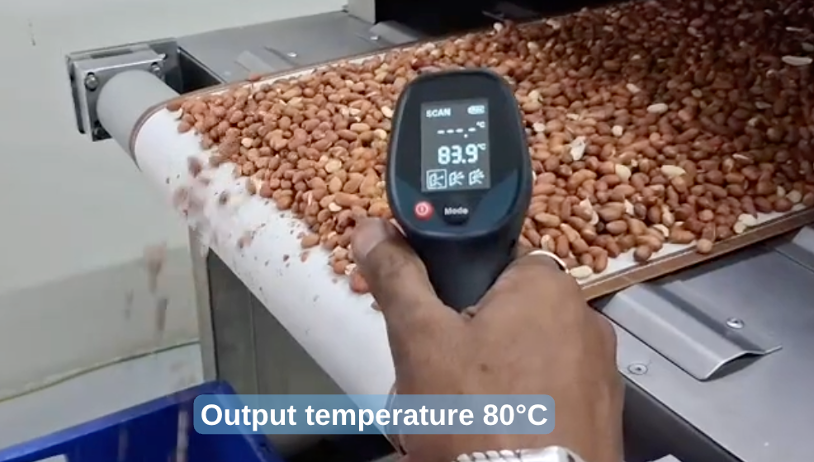
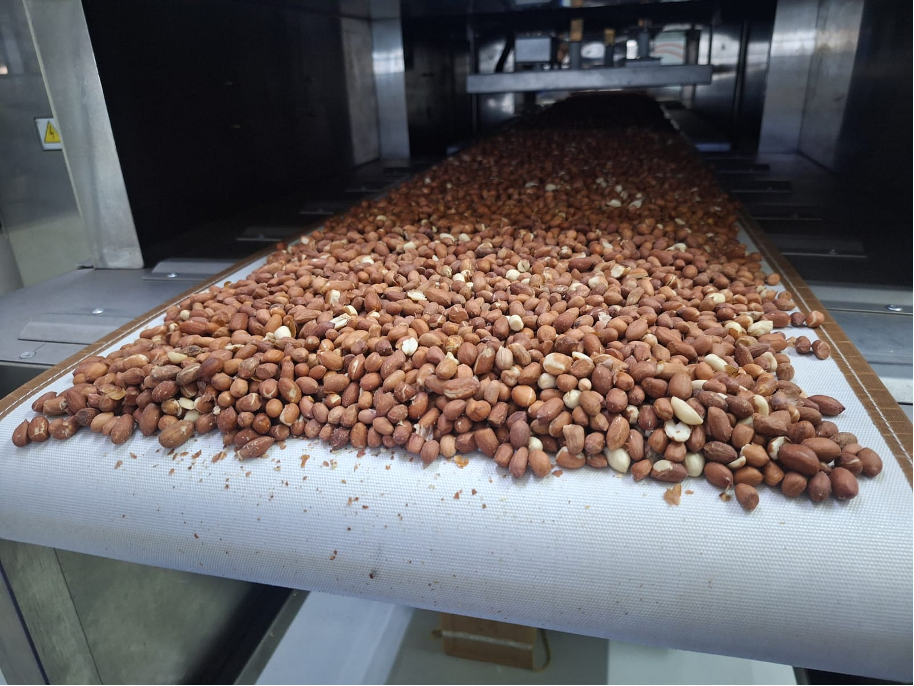
The trial was conducted on a 50 kg batch of raw peanut kernels intentionally selected as a worst-case sample due to its heavy insect infestation. The batch contained multiple stored-product insect species, including adults and larvae, providing a realistic assessment of RF performance under challenging processing conditions.
Process Parameters
| Parameter | Value |
| Product | Raw Peanut Kernels |
| Batch Size | 50 kg |
| Target Product Temperature | 50–70°C |
| Dwell Time | 10–30 minutes |
| Treatment Objective | Radio Frequency Disinfestation |
Independent Validation
To independently verify the effectiveness of the RF treatment, representative samples were submitted to a third-party laboratory for evaluation.
The assessment included:
- Visual inspection for live adult insects and larvae.
- Destructive examination of peanut kernels for internal infestation.
- Incubation of treated and untreated samples in breathable pouches to monitor any surviving insect activity over time.
This independent evaluation provided objective verification of the disinfestation performance achieved by the RF process.
Trial Results
Following RF treatment, both the treated and untreated samples were independently evaluated using visual inspection, destructive examination of kernels, and post-treatment incubation. The results demonstrated a clear difference between the control and RF-treated samples.
Results Summary
| Untreated Control | RF Treated Sample |
| Live moths, beetles and larvae present | No live insects detected |
| Internal larvae present | All internal larvae dead |
| Continued insect activity | 100% immediate knockdown |
Key Findings
The independent validation confirmed that Radio Frequency treatment:
- Achieved 100% immediate knockdown of active insects and larvae.
- Eliminated insects both on the surface and inside peanut kernels.
- Provided a chemical-free alternative to conventional fumigation.
- Demonstrated effective performance under worst-case infestation conditions.
Conclusion
This trial demonstrates that Radio Frequency technology is an effective solution for the disinfestation of raw peanuts. By selectively heating insects faster than the surrounding product, RF achieved 100% immediate knockdown of active insects and larvae without the use of chemical fumigants. These results highlight the potential of RF technology as a reliable and scalable solution for commercial peanut processors seeking improved food safety and export compliance.
Book a demo
This pilot trial was carried out at the Strayfield RF Experience Centre, where customers can validate product performance, optimise process parameters, and evaluate the benefits of RF technology before full-scale implementation. Contact Strayfield to book a pilot trial at our RF Experience Centre and validate your application under real production conditions.
