
Microwave heating is widely recognised thanks to its household use, while Radio Frequency (RF) heating often remains misunderstood outside industrial circles. Although both technologies rely on electromagnetic energy, they behave very differently once they interact with materials.
Understanding these differences is critical when evaluating heating uniformity, penetration depth, scalability, and process control across industrial applications.
This article breaks down RF vs microwave heating from a purely technical perspective—how they work, where they differ, and why those differences matter.
The Fundamental Difference: Frequency and Wavelength
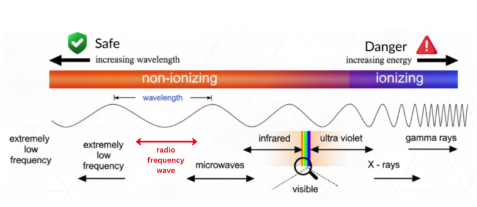
At the core of RF vs microwave technology is frequency.

Radio Frequency heating operates at much lower frequencies (commonly around 27 MHz)

Microwave heating operates at much higher frequencies (typically 900 MHz and above)
Lower frequency means longer wavelengths, and this single distinction influences nearly every performance outcome—penetration, heating pattern, and uniformity
Uniform Heating: Field Heating vs Standing Waves
Why RF Heats More Evenly
Radio Frequency systems generate a broad, uniform electromagnetic field. This field fills the entire processing space, allowing energy to be distributed consistently across the material.
Key outcomes:
- Reduced hot and cold spots
- Stable heating across the full volume
- Predictable process control
Why Microwave Heating Struggles at Scale
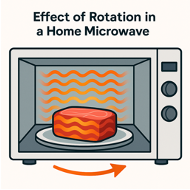
Microwaves produce shorter wavelengths that form standing wave patterns with peaks and troughs. This is why even household microwaves rely on turntables—to mechanically compensate for uneven energy distribution.
At an industrial scale, this unevenness becomes harder to manage, especially as the process tunnel volume increased to meet high throughput
Penetration Depth: Surface Heating vs Volumetric Heating
RF = True Volumetric Heating
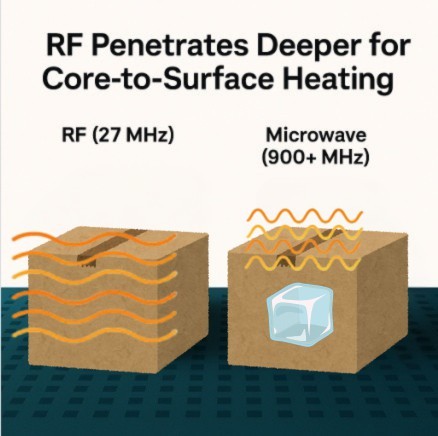
Because RF energy operates at lower frequencies, it penetrates deep into materials, allowing the core and surface to heat simultaneously.
Benefits include:
- No thermal gradients
- Reduced risk of surface overheating
- Consistent internal temperatures
Microwave = Surface-Dominant Heating
Microwave energy is absorbed much more quickly near the surface as the penetration depth decreases at higher microwave frequencies. As a result:
- Outer layers heat rapidly
- Inner regions lag behind
- Longer processing times or uneven results may occur
This difference in penetration is one of the most critical technical distinctions between RF and microwave systems.
Process Stability and Throughput Control
RF Systems: Designed for Industrial Scale
RF heating systems are naturally suited for:
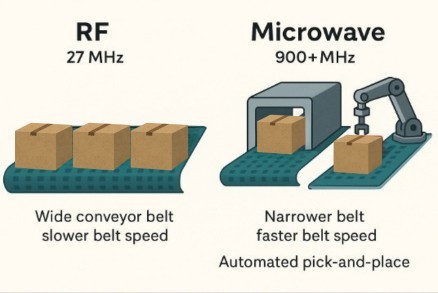
- Wider processing zones
- Slower material movement with the same output
- Stable throughput without aggressive automation
The broader electromagnetic field allows RF systems to maintain process consistency even at higher volumes.
Microwave Systems: Tighter Constraints
Microwave systems often require:
- Narrower tunnels
- Higher belt speeds
- Additional synchronisation and automation
As scale increases, managing uniformity becomes increasingly complex.
Energy Behaviour: Controlled Transfer vs Reactive Absorption
Industrial RF systems couple energy into the product based on its dielectric loss characteristics. When little or no lossy material is present, effective power transfer collapses and RF generators automatically limit output or idle, resulting in significantly reduced energy consumption.
Microwave systems—particularly magnetron-based designs—operate at largely fixed output power. When product absorption is low or absent, the unused energy is dissipated in dummy loads or cavity losses rather than being productively absorbed, leading to lower process efficiency and continued electrical power draw.
In most practical industrial installations, Microwave systems scale less gracefully where more modules are required for the same output power as compared to RF systems
Safety and Industrial Integration
Both RF and microwave technologies are safe when designed and installed correctly. However, RF systems benefit from:
- Lower operating frequencies
- Predictable electromagnetic behaviour
- Easier compliance management in industrial environments
This makes RF particularly well-suited for continuous, large-scale processing environments.
RF vs Microwave: A Ǫuick Technical Comparison
| Parameter | Radio Frequency Heating | Microwave Heating |
| Frequency Range | Low (≈27 MHz) | High (900+ MHz) |
| Wavelength | Long | Short |
| Heating Pattern | Uniform field | Standing waves |
| Penetration Depth | Deep | Surface-dominant |
| Scale Suitability | Excellent | Limited |
| Process Control | High | Variable |
Conclusion: Choosing the Right Technology
While microwave technology is effective for small-scale, intermittent heating, Radio Frequency heating excels in uniformity, penetration, and scalability.
When process consistency, material integrity, and industrial throughput matter, RF heating offers clear technical advantages over microwave systems.
Understanding these fundamentals allows engineers, processors, and decision-makers to select the right technology—not based on familiarity, but on physics.
